
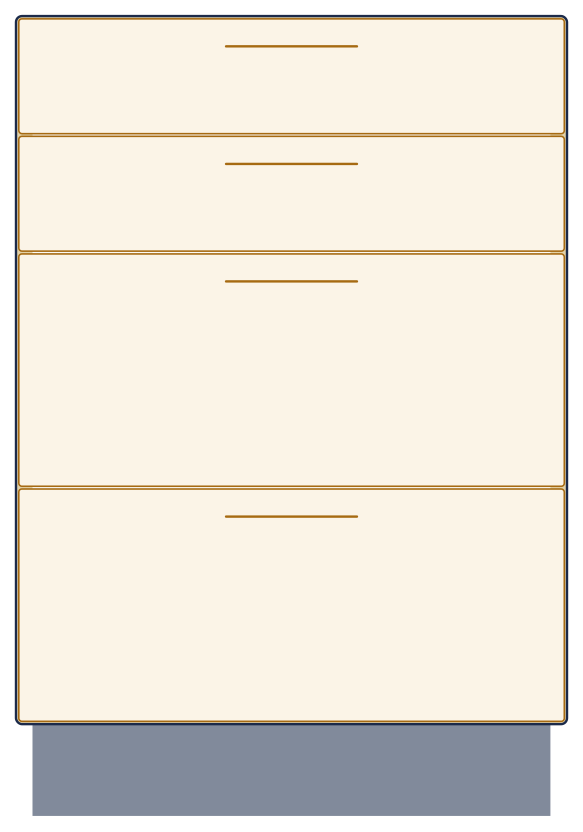
A workbench with drawers starts with a good base cabinet. This one is 600 mm (23 5/8 in) wide, 871 mm (34 5/16 in) tall and 600 mm deep, in 18 mm (about 3/4 in) birch plywood with a 6 mm (1/4 in) back. You add a top of your choice; it is not in the cut list. Put two or three side by side for a long bench.
The design is metric, because the drawer grid is: 32 mm steps do not map onto inches. The cut list is in millimetres, with inches in brackets in the text.
Height: wrist height
A common rule of thumb for bench height is wrist height: stand upright with your arms at your sides and measure from the floor to your wrist (Fine Woodworking, Bosch). Fine Woodworking notes that standard benches are usually 36 in tall, lower for planing and higher for sawing dovetails or carving. This cabinet is 871 mm (34 5/16 in); with a 1 1/2 in top, such as the butcher block tops Home Depot lists (MSI, 1 1/2 in), it comes to about 35 13/16 in. If your wrist is higher or lower, change the cabinet height in the cabinet designer.
Four drawers on the 32 mm system
The 32 mm system is the standard of European cabinetmaking: 5 mm holes every 32 mm, the first row 37 mm from the front (Wikipedia, Festool). Most cabinet hardware is made for it. This cabinet puts its drawers on slots of 128 mm, four times 32. A drawer is 1 or 2 slots tall; its front is the slot minus a 3 mm gap, so 125 or 253 mm (4 15/16 or 9 15/16 in). Kitchen makers do the same with their own unit: Nobilia divides a 720 mm carcass into slots of 144 and makes fronts of 141, 285 and 573 mm.
- Two shallow drawers at the top, one slot each, for screws, bits and measuring tools.
- Two deep drawers at the bottom, two slots each, for power tools and cases.
Because every slot is the same height, the runners of all drawers sit on a fixed rhythm. Later you can swap a deep drawer for two shallow ones without measuring.
The spacer strip: runners without measuring
The cut list has a spacer strip of 550 × 82.3 mm. That is a 128 mm slot minus the height of the runner, 45.7 mm (1.8 in, the height of a common ball-bearing slide such as the Accuride 3832). Screw the bottom runner in place, lay the strip on it against the side and set the next runner on the strip: it is then exactly 128 mm higher and parallel over its full length. That is what matters, because slides must be mounted parallel, vertically and horizontally (Accuride). If your runner is not 45.7 mm tall, cut the strip to 128 minus the height of your runner. The strip is a jig of our own, not a factory part.
Stretchers instead of a solid top
A base cabinet that gets a countertop usually has no solid top (The Handyman's Daughter). Two 100 mm (3 15/16 in) stretchers, front and back, hold the sides apart at the top, and you screw the top on from below through them. Fine Homebuilding uses a 4 in wide stretcher rail on built-in base cabinets, about the same size. If you use the cabinet without a top, choose a solid top in the cabinet designer.
Back panel and toe kick
Stretchers do not keep a cabinet square; a panel on the back does. A sheet takes the racking forces in its plane, like a sheathed wall (APA), and a back of slats is not rigid enough (Fine Woodworking). That is why this cabinet has a 6 mm back screwed onto the back edges. For drawers it matters even more: a racked cabinet puts the runners out of line.
The toe kick is 100 mm (3 15/16 in) tall and set back 60 mm (2 3/8 in), so your feet go under the cabinet and you stand closer to the top. That is close to a kitchen toe kick: KraftMaid makes theirs 3 1/8 in deep (spec book). We found no source for toe kicks on workbenches specifically, but you stand at it the same way as at a counter. The bottom panel runs over the full width and depth, the sides stand on it and the toe kick goes underneath: a front rail, two side plinths that are 60 mm shorter, and behind them a base frame of rough softwood that carries the cabinet. The cabinet designer puts that frame (5 rails, 46 × 100 mm) in the linear cut list, not in the panel cut list.
Fix the cabinet. A cabinet with drawers tips sooner than it looks when a full drawer is open, and furniture with drawers should be anchored against tipping (Anchor It). Screw the top on through the stretchers and fix the cabinet to the wall or to the next cabinet. The cabinet designer flags it under Stability too.
What you need
- 4 pairs of full-extension drawer slides. The cabinet designer counts 550 mm; the nearest US stock length is 22 in (559 mm), which fits the 590 mm (23 1/4 in) drawer boxes.
- Rough softwood for the base frame under the toe kick (in the linear cut list) and wall anchors that suit your wall.
- Cam fittings and dowels for the carcass, and 4 handles; the cabinet designer counts them in What do I need.
- 18 mm birch plywood and 6 mm plywood for the back and drawer bottoms (see the cut list).
- A top, such as butcher block or a laminated worktop. It is not in the cut list.
Full-extension side-mount slides are store stock, for example Everbilt 22 in at Home Depot or RELIABILT 22 in at Lowe's, both rated 100 lb per pair. Measure the thickness of your plywood and set it in the cabinet designer before you cut; sheets sold as 3/4 in are often a little thinner.
Dimensions
- Outer size: 600 × 871 × 600 mm (23 5/8 × 34 5/16 × 23 5/8 in), width × height × depth, without the top
- Toe kick 100 mm (3 15/16 in) tall, set back 60 mm (2 3/8 in), under a continuous bottom panel
- Four drawers on 128 mm slots: fronts 125, 125, 253 and 253 mm
- 18 mm birch plywood, back and drawer bottoms 6 mm
Panel sizes (cut list)
| Part | Size (mm) | Qty | Material | Thickness |
|---|---|---|---|---|
| Side | 753 × 600 | 2 | Plywood (birch) | 18 mm |
| Top stretcher, front | 564 × 100 | 1 | Plywood (birch) | 18 mm |
| Top stretcher, back | 564 × 100 | 1 | Plywood (birch) | 18 mm |
| Bottom panel | 600 × 600 | 1 | Plywood (birch) | 18 mm |
| Back panel | 600 × 771 | 1 | Plywood (birch) | 6 mm |
| Plinth | 564 × 100 | 1 | Plywood (birch) | 18 mm |
| Side plinth | 540 × 100 | 2 | Plywood (birch) | 18 mm |
| Drawer front | 594 × 125 | 2 | Plywood (birch) | 18 mm |
| Drawer side | 590 × 83 | 4 | Plywood (birch) | 18 mm |
| Drawer back | 503 × 83 | 2 | Plywood (birch) | 18 mm |
| Drawer bottom | 503 × 572 | 4 | Plywood (birch) | 6 mm |
| Drawer front | 594 × 253 | 2 | Plywood (birch) | 18 mm |
| Drawer side | 590 × 211 | 4 | Plywood (birch) | 18 mm |
| Drawer back | 503 × 211 | 2 | Plywood (birch) | 18 mm |
| Spacer strip | 550 × 82.3 | 1 | Plywood (birch) | 18 mm |
Open this project in the cabinet designer with the button below. You see the cabinet in 2D and 3D, with the cut list, the cutting plan and What do I need. Rather save it yourself? Download the project file and open it via Open › Load project.
What the cabinet designer does
For the drawers, choose the Grid layout; every drawer is then 1, 2 or 3 slots tall, and drawers of the same height can swap places. For the top choose Stretchers or a solid top, for the toe kick the Setback. The build guide drills the runner holes at every slot, including where no drawer starts yet, and sets the runners with the spacer strip. The cabinet is also in the gallery as the cabinet type Workbench cabinet.
Frequently asked questions
How tall should a workbench be?
A common rule of thumb is wrist height: stand upright with your arms at your sides and measure from the floor to your wrist. Fine Woodworking and Bosch both give that rule, and Fine Woodworking notes that standard benches are usually 36 in tall. Change the cabinet height and add the thickness of your top.
Can I move or split a drawer later?
Yes, that is the point of the grid. Every slot is 128 mm (about 5 in) tall and the holes for the runners are drilled at every slot. You can swap a tall two-slot drawer for two short ones without drilling in the finished cabinet. The build guide drills the holes for all slots up front.
Can it be wider, for a long workbench?
Yes. Put several cabinets side by side under one top, or make the cabinet wider in the cabinet designer; the drawers, stretchers and cut list follow. For wide drawers you can choose a thicker drawer bottom in the cabinet designer.