
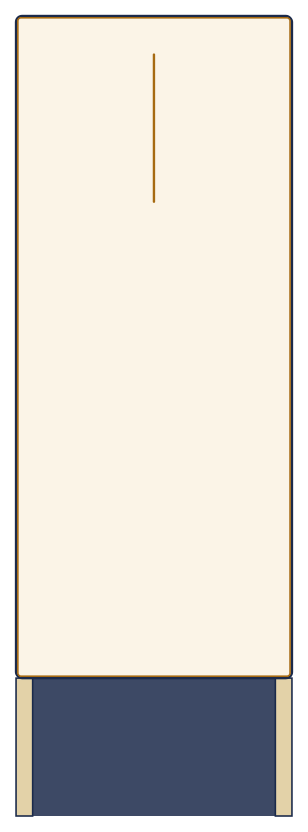
A narrow pull-out pantry next to the range or the fridge turns a gap of about a foot into storage you pull all the way out. This example is 300 mm (11 13/16 in) wide, 870 mm (34 1/4 in) tall and 560 mm (22 1/16 in) deep, in 18 mm (about 3/4 in) birch plywood with a 6 mm (1/4 in) back. The pull-out has two adjustable shelves and is open on both sides.
A metric cabinet, and how to size it for a US kitchen
This design is metric, because it follows European kitchen sizes: a 720 mm (28 3/8 in) carcass on a 150 mm (5 7/8 in) plinth, a common size in German kitchens (Nobilia builds its base cabinets 720 mm tall and 561 mm deep). The cut list below is in millimetres.
A US base cabinet is different. KraftMaid gives 34 1/2 in tall (36 in with a 1 1/2 in countertop) and 24 in deep, with a toe kick 4 1/2 in high and 3 1/8 in deep (spec book). Store-bought base pantry pull-outs come in 9, 12 and 15 in widths (Rev-A-Shelf 448; KraftMaid sells 9 and 12 in). 12 in (305 mm) is the closest to this example. The plinth here is flush with the front; for toe space like in a kitchen, set Setback to about 3 in. To build it to US sizes, open the example and set the outer size to 12 × 34 1/2 × 24 in and the plinth to 4 1/2 in; every part is recalculated. See the FAQ below for the slide length.
How the pull-out is built
- Mounting strip on the bottom. A strip 50 mm (2 in) tall and 548 mm long stands on edge on the cabinet bottom, in the centre.
- Bottom slide upright. The cabinet member of a 550 mm full-extension ball-bearing slide stands upright against that strip. The drawer member goes on a second strip hanging under the bottom of the pull-out. That way the slide carries in the position it is made for.
- Top slide flat. A second slide lies flat under the top of the cabinet. It carries nothing; it keeps the pull-out upright.
- The pull-out itself is a frame of front wall, back wall, bottom and top, 258 mm (10 3/16 in) wide and 616 mm (24 1/4 in) tall, with two adjustable shelves. The 294 × 714 mm front goes on the front wall.
Why upright: a ball-bearing slide mounted flat carries less than the same slide mounted on its side. Accuride writes that flat mounting lowers the load rating, and some slides may not be mounted flat at all (Accuride 3832 data sheet: side mounting only). So check the data sheet of your slide before you mount it flat at the top.
Store-bought hardware works differently. In a base cabinet a ready-made pantry pull-out usually runs on its own runners under or beside the unit: KraftMaid's base pantry pull-out slides on "full-extension under-mount soft-close runners", and Rev-A-Shelf mounts on its own slides with door brackets (KraftMaid spec book, Rev-A-Shelf 448). That hardware has its own frame. This design uses only plain slides, and you stand the bottom one upright against a strip because there is no side wall in the middle of the cabinet bottom to screw it to.
Depth and slide length
A 550 mm slide needs at least 554 mm (21 13/16 in) inside depth, according to the Hettich data at a German store (Hornbach product page). The back panel is screwed onto the back, so the full 560 mm of the side stays free. If you set the back in a groove, measure again: it gets tight.
Fix the cabinet to the wall. With a full pull-out open, the weight sits in front of the cabinet. Factory base cabinets are screwed to the wall through the top back rail (Hampton Bay installation guide), and furniture with drawers should be anchored against tipping (Anchor It). The cabinet designer counts two anchors in What do I need.
Heavy stock? The 100 lb on the box is for a pair of slides, both on the sides. Nobody gives a figure for this layout. For more margin, choose 1 heavy under Slides: a heavy-duty slide at the bottom, a regular one at the top. Home Depot stocks Knape & Vogt 8810 heavy-duty slides, 200 lb per pair and 3/4 in thick (Home Depot); the mounting strip gets taller with them. The example uses a regular slide.
What you need
- 1 pair of full-extension ball-bearing slides, 550 mm: one at the bottom, one at the top. The nearest US stock length is 22 in (559 mm); see the FAQ.
- 8 shelf pins for the two adjustable shelves, and a rail for the shelves: the pull-out is open on the sides.
- 2 wall anchors that suit your wall.
- Rough softwood for the base frame under the plinth: 3 rails, 63 × 150 mm, in the linear cut list.
- Cam fittings and dowels for the carcass, and 1 handle; the cabinet designer counts them in What do I need.
- 18 mm birch plywood and 6 mm plywood for the back (see the cut list). The countertop is not in the cut list.
Full-extension side-mount slides are store stock, for example Everbilt 22 in at Home Depot (rated 100 lb per pair). The cabinet designer assumes a slide about 45 mm (1 3/4 in) tall and 12.7 mm (1/2 in) thick; if yours differs, change it in the planner.
Dimensions
- Outer size: 300 × 870 × 560 mm (11 13/16 × 34 1/4 × 22 1/16 in), width × height × depth
- Carcass 720 mm (28 3/8 in) tall on a 150 mm (5 7/8 in) plinth
- Pull-out 258 mm wide, 616 mm tall, 550 mm long, on 550 mm slides
- 18 mm birch plywood, 6 mm back panel
Panel sizes (cut list)
In the cabinet designer the pull-out is a cabinet of its own, A1, linked to cabinet A. That is why it has its own rows; its sizes follow when you change A. The cut list is in millimetres.
| Cabinet | Part | Size (mm) | Qty | Material | Thickness |
|---|---|---|---|---|---|
| A | Side | 870 × 560 | 2 | Plywood (birch) | 18 mm |
| A | Top / bottom | 264 × 560 | 2 | Plywood (birch) | 18 mm |
| A | Back panel | 300 × 720 | 1 | Plywood (birch) | 6 mm |
| A | Plinth | 264 × 150 | 1 | Plywood (birch) | 18 mm |
| A | Mounting strip | 548 × 50 | 1 | Plywood (birch) | 18 mm |
| A | Pull-out front | 294 × 714 | 1 | Plywood (birch) | 18 mm |
| A1 (pull-out of A) | Pull-out front wall | 616 × 258 | 1 | Plywood (birch) | 18 mm |
| A1 (pull-out of A) | Pull-out back wall | 616 × 258 | 1 | Plywood (birch) | 18 mm |
| A1 (pull-out of A) | Bottom / top | 514 × 258 | 2 | Plywood (birch) | 18 mm |
| A1 (pull-out of A) | Adjustable shelf | 510 × 258 | 2 | Plywood (birch) | 18 mm |
| A1 (pull-out of A) | Mounting strip | 548 × 50 | 1 | Plywood (birch) | 18 mm |
Open this project in the cabinet designer with the button below. You see the cabinet in 2D and 3D, with the cut list, the cutting plan and What do I need. Rather save it yourself? Download the project file and open it via Open › Load project.
What the cabinet designer does
Choose + Pull-out pantry in an empty bay. The cabinet designer sizes the pull-out and the mounting strips, picks the longest slide that fits and draws the cross-section with both slides. In 3D, tap the front to open the pull-out. The build guide screws the slides to the mounting strips and under the top on the workbench first, assembles the cabinet and then slides the pull-out in; if it runs stiff, you adjust the top slide. The cabinet is also in the gallery as the cabinet type Pull-out pantry.
Frequently asked questions
Can I build it to US base cabinet sizes?
Yes. Set the outer size to 12 × 34 1/2 × 24 in and the plinth to 4 1/2 in in the cabinet designer. It then picks a 600 mm slide, which is not a US stock length. Set Slide length to 550 and buy 22 in (559 mm) slides: the slide then ends 9 mm behind the pull-out, and a 24 in deep cabinet has the room.
How much weight can the pull-out carry?
Manufacturers rate slides per pair, both mounted on the sides. For one slide upright at the bottom and one flat at the top, nobody gives a figure. Keep heavy jars and bottles low, and for a lot of cans choose the 1 heavy option: a heavy-duty slide at the bottom.
Can it be wider or narrower?
Yes. Change the width in the cabinet designer; the pull-out, the mounting strips and the cut list follow. Up to a 400 mm (15 3/4 in) wide pull-out there is one slide in the centre at the bottom and top, above that two. The pull-out is 6 mm (1/4 in) narrower than the inside of the cabinet: 3 mm (1/8 in) clearance per side.