
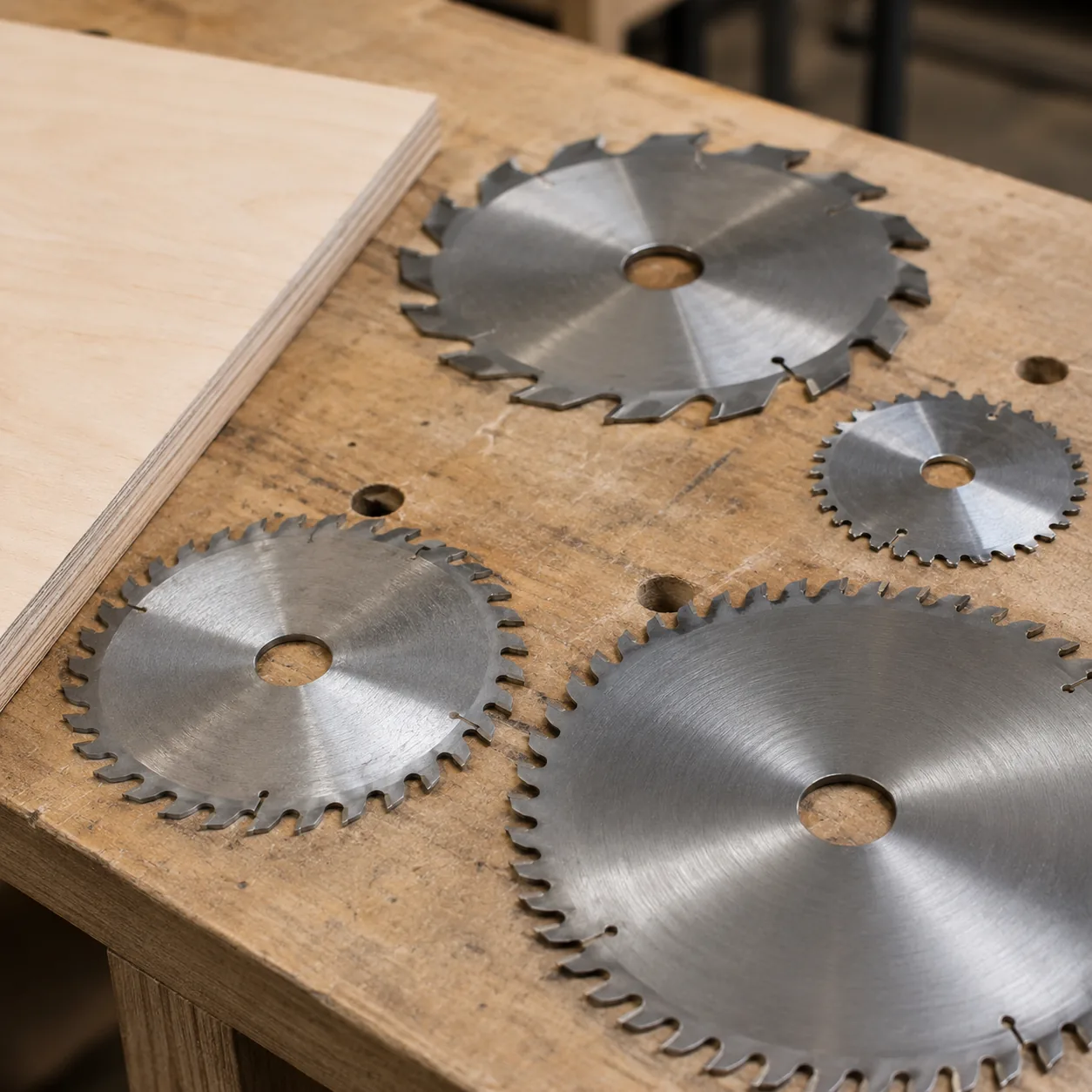
Three things that decide the cut
Choosing a blade sounds complicated, but for sheet goods it comes down to three things: the number of teeth, the shape of the teeth, and the hook angle. Together they decide whether your edge is smooth and chip-free or ragged and torn. The diameter obviously has to match your saw, and the thinner the cut (kerf), the less material and power you waste.
Tooth count: more teeth, cleaner cut
Rule of thumb: more teeth gives a smoother cut but feeds slower, fewer teeth cuts faster but rougher. For sheet goods you want a fine-toothed blade. On a hand-held circular saw (often 6 to 7-1/4 inch) about 40 to 60 teeth works well; on a table or mitre saw (10 inch) more like 60 to 80. For melamine, laminate and nice veneer, use the highest tooth count you can get.
Tooth shape: ATB for wood, TCG for melamine
The two shapes you will meet:
- ATB (alternate top bevel). The teeth slice the wood fibres cleanly, ideal for plywood, solid wood and plain MDF.
- TCG (triple chip grind, a flat tooth alternating with a chamfered one). Tougher and longer-lasting, and chips less. This is the choice for melamine, laminate and hard or dense panels.
Hook angle: low or negative for melamine
The hook angle is the angle at which the tooth attacks the material. A high (positive) hook cuts aggressively and fast, good for softwood. For melamine and laminate you want a low or even negative hook: it lifts the coating less and chips less. On some machines (like a mitre saw) a low hook is also safer because the blade pulls the workpiece toward you less.
Quick pick by material
| Material | Teeth | Shape | Watch out |
|---|---|---|---|
| Plywood | Many (40-60+) | ATB | Good face up on a hand-held circular saw |
| MDF | Many | ATB | MDF dulls blades faster; keep it sharp |
| Melamine / laminate | Very many | TCG, low/negative hook | Splinter strip or scoring pass against chipping |
| Particleboard | Many | ATB or TCG | Hard and abrasive; TCG lasts longer |
| Solid wood | Fewer is fine | ATB | For ripping the tooth count can be lower |
Sharp beats expensive
The best blade chips as soon as it goes dull. A dull or gummed-up blade (resin build-up) is by far the most common cause of a ragged edge, burn marks and hard going. Keep your blade sharp and clean, and have a good carbide blade resharpened rather than thrown away. And account for the kerf: set your blade's kerf in the tool (often around 3 mm or 1/8 inch) so your parts come out to size.
Lay out your cuts first. Open the free tool, set your kerf and see the panel sizes and cutting plan. No account, nothing to install.
Frequently asked questions
How many teeth should a blade for sheet goods have?
Fine-toothed: on a hand-held circular saw about 40 to 60 teeth, on a table or mitre saw (10 inch) more like 60 to 80. For melamine and veneer, the highest tooth count.
What is the difference between ATB and TCG?
ATB slices fibres cleanly (plywood and wood). TCG chips less and is tougher, the choice for melamine, laminate and hard panels.
Which blade cuts melamine without chipping?
A fine-toothed, sharp TCG blade with a low or negative hook, good face up, plus a splinter strip or scoring pass. A dull blade is the main cause of chipping.