
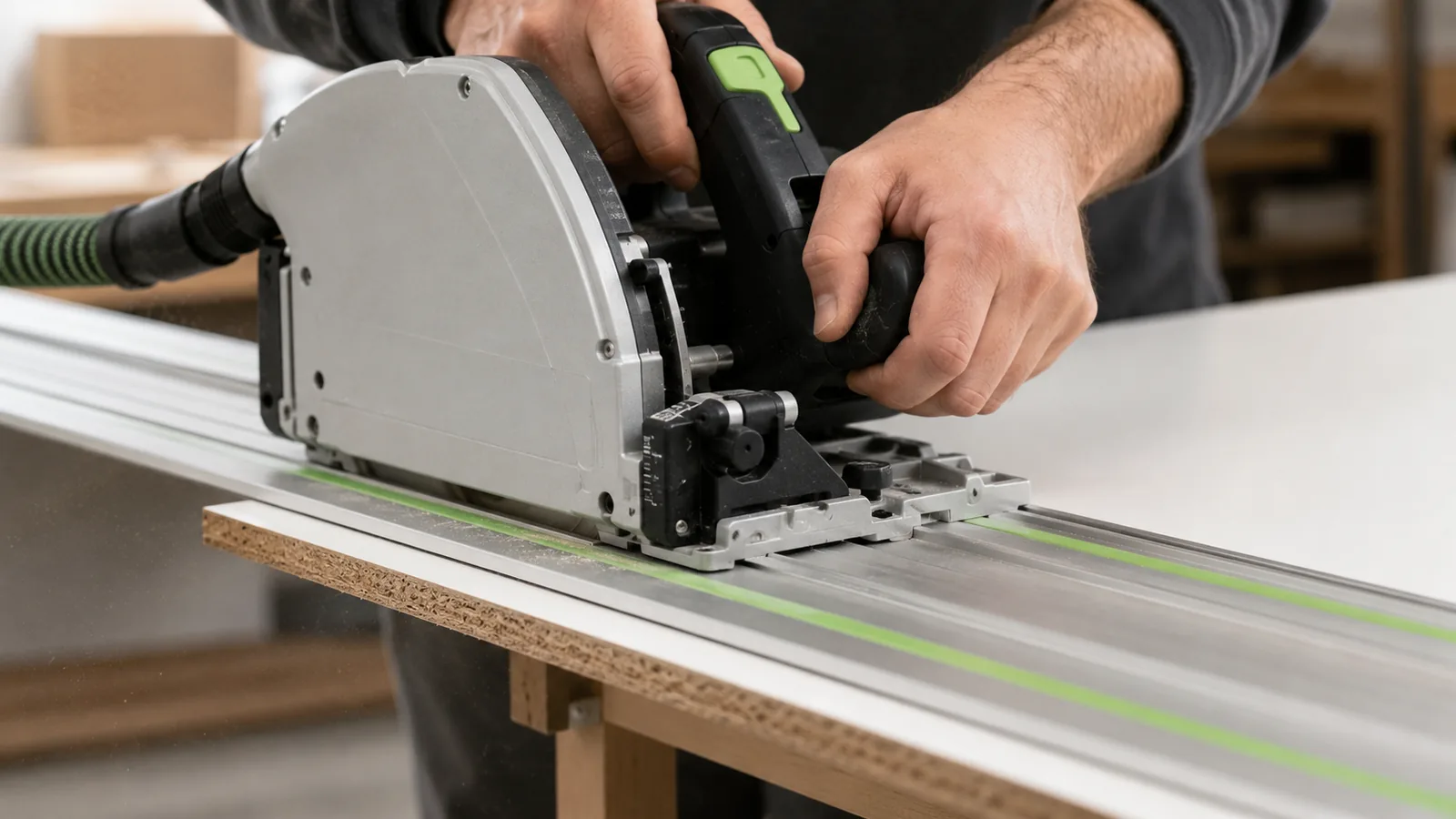
Why a plunge saw on a rail
Cutting a big sheet of plywood or MDF dead straight on your own with a freehand circular saw is hard: the saw wants to drift and the edge is rarely perfect. A plunge saw fixes that. The blade sits recessed in the housing and you lower it into the sheet from above while the saw slides along an aluminium guide rail. The rail sets the line, not your hand, so the cut comes out straight and repeatable. And because you can plunge the blade into the middle of a sheet, you can make cut-outs too, not just edges.
Laying the rail correctly
The rail has anti-slip strips underneath so it stays put, and a rubber splinter strip along the cutting side. That strip sits exactly where the blade cuts. So lay the rail with the edge of the splinter strip on your marked line, and you cut right on the line. With a new rail you trim the splinter strip to size on the first cut; after that it gives you a reliable zero line. Clamp the rail for longer cuts, especially when working alone.
Depth and splinters
Set the cutting depth so the blade just clears the sheet plus a few millimetres. That way you cut neatly into a sacrificial board (a thin sheet, or two battens on trestles) rather than your bench, and you keep the underside cleaner. For splinter-free cuts it also helps to use a sharp, fine-toothed blade made for sheet goods, keep the good face up, and feed slowly and evenly. Support the sheet right next to the cut to stop tear-out underneath.
Plunging safely
- Check the sheet is well supported and cannot tip or pinch the blade.
- Hold the saw firmly against the rail and let the blade plunge gently before you move forward.
- Cut away from yourself, both hands on the machine, and stay out of the line behind the saw (kickback).
- Let the blade stop completely before you lift the saw.
- Manage dust: sheet goods, and MDF in particular, throw fine dust. Connect a vacuum and wear a mask.
Plunge saw, circular saw, or have it cut?
If you have a lot of straight cuts in sheet goods, a plunge saw on a rail is the nicest and cleanest option at home. A regular circular saw on a rail works too, but does not plunge and tends to splinter more. And if you do not have the tools, or want to skip the heavy lifting, have the big sheets cut at the store and do only the fine work at home. Either way it helps to have your cut list and an efficient cutting plan ready first.
Ready to lay it out? Open the free tool, enter your parts and get the panel sizes plus a numbered cutting order. No account, nothing to install.
Frequently asked questions
What is the difference between a plunge saw and a circular saw?
A plunge saw drops the blade in from above and runs on a guide rail, so it cuts very straight and can start mid-panel. A circular saw can use a rail too, but the plunge saw is built for it and cuts cleaner and safer.
How do I avoid splinters with a plunge saw?
The splinter strip on the rail holds the fibres down at the cut line. Use a sharp, fine-toothed blade for sheet goods, keep the good face up, and feed slowly.
How deep should I set the plunge saw?
Just through the sheet plus a few millimetres, so you cut into a sacrificial board, not your bench. Too deep causes more tear-out and is needlessly dangerous.