
The materials in short
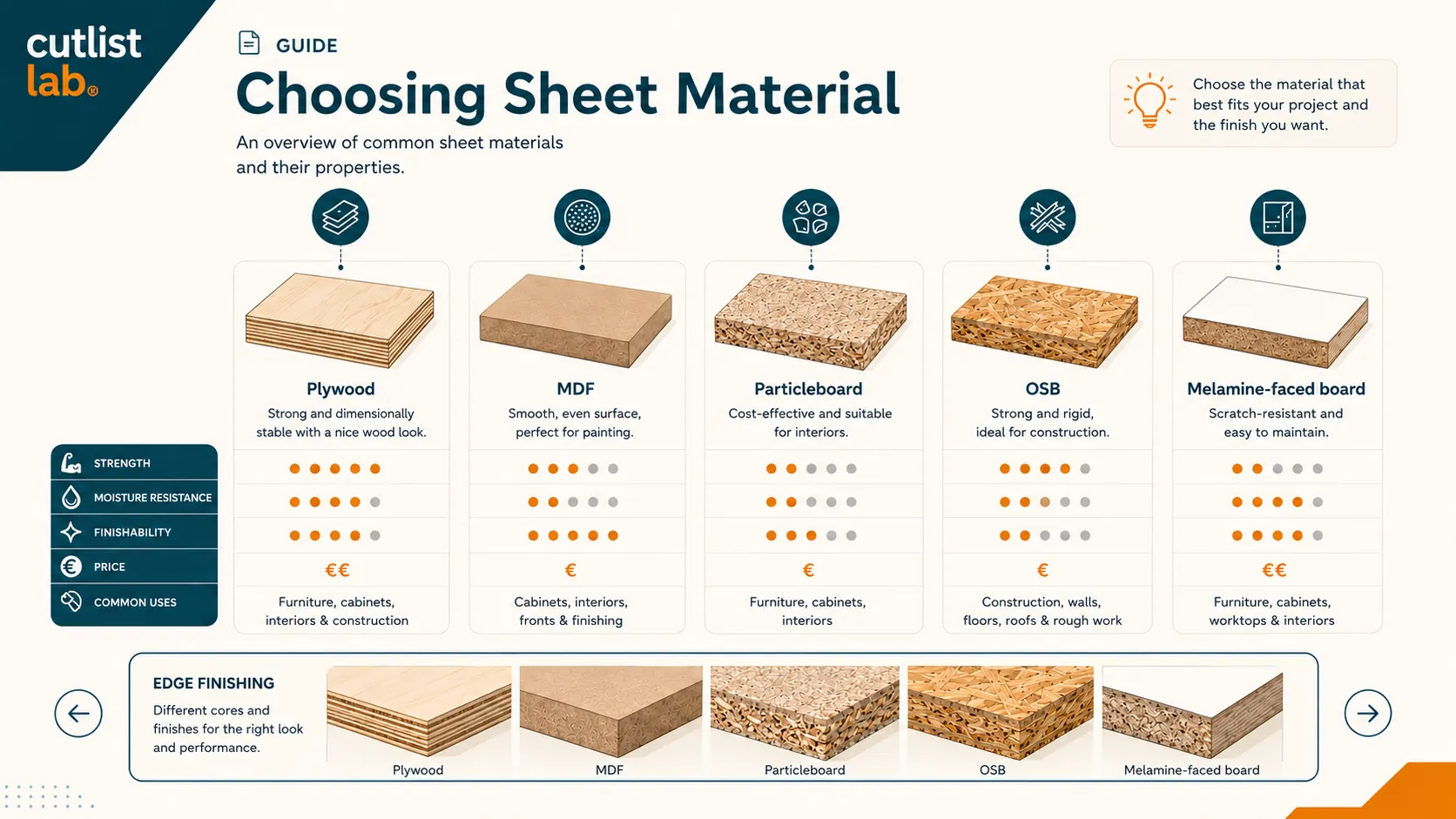
| Material | Strength | Finish | Moisture | Price per m² (3/4″)* | Typical use |
|---|---|---|---|---|---|
| Plywood | High, stiff | Clean edge possible, has grain | Fair to good (depends on grade) | ± $18 | Cabinets, furniture, visible work |
| MDF | Medium | Even, smooth, ideal for paint | Sensitive (MR grade is better, not waterproof) | ± $12 | Painted fronts, trim, interior parts |
| Particleboard | Lower | Rough, usually faced with melamine | Sensitive (unless moisture-resistant) | ± $11 | Budget cabinets, hidden work |
| Melamine board | Lower to medium | Ready-made white or wood decor | Facing helps, core stays sensitive | ± $18 | Cabinet interiors, shelves |
| OSB | High (structural) | Coarse, industrial look | OSB/3: humid air fine, edges swell when wet | ± $9 | Sheathing, structure, rugged look |
| Hardboard | Thin, stiff in plane | One smooth side | Sensitive | 1/8″: ± $6 | Back panels, drawer bottoms |
| Underlayment plywood | High | Flat, fine surface | Exterior-glued; open edges stay vulnerable | Medium | Subfloors, flat substrate |
| Film-faced plywood | High | Smooth, waterproof film | Very good, if you seal the cut edges | High | Forms, work surfaces, outdoors |
* Median of 311 products at a US home center (own measurement, June 2026). Indication only; prices vary by region and week.
Below, in short, what each material is good at and what to watch for.
Plywood
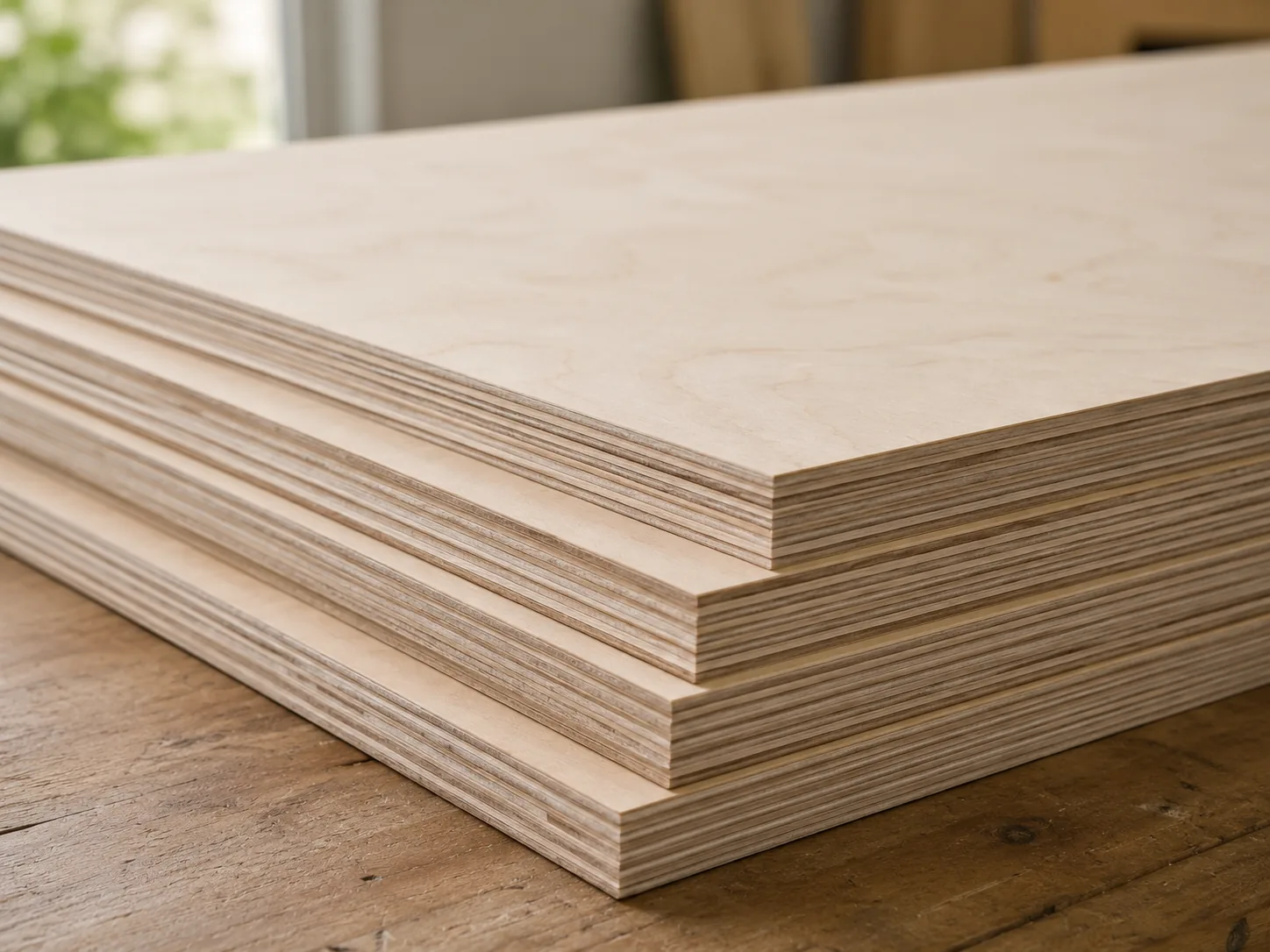
Plywood is made of thin veneers glued crosswise (a 3/4″ birch sheet has 13 of them). That makes it strong, stiff and good at holding screws. But "plywood" is not one material; the species matters a lot:
- Birch: the stiffest and heaviest common kind (± 680 kg/m³), with a dense, attractive edge you can leave exposed; the favorite for visible furniture, at the highest price.
- Poplar: much lighter (± 450 kg/m³) and cheaper, roughly half as stiff as birch; fine for light interior work, but often interior-glued and weaker at holding screws.
- Pine / softwood sheathing grades: exterior-glued construction plywood, rougher faces with knots and patches; strong and cheap, less pretty.
Plywood has a grain on the outer layer, so for a clean look you run visible parts in the same direction. For outdoor use, three things must hold up: waterproof glue, a species that tolerates moisture, and a finish; "exterior glued" alone is not enough.
MDF
MDF is pressed wood fiber: even, grain-free and dead flat. It routs, profiles and paints beautifully, so for smooth sprayed fronts and molding it is the favorite. Downsides: it is heavy, the edges are porous (edge banding or primer needed) and standard MDF swells when wet. In a bathroom or kitchen, choose moisture-resistant MDF (often colored green), but know what you are buying: it is rated for humid air and incidental moisture, not for standing water. Moisture-resistant is not waterproof, and it costs roughly twice as much as standard MDF.
Particleboard and melamine board
Particleboard is pressed wood chips: cheap and nicely flat, but less strong and sensitive to moisture. You rarely see it bare; usually it carries a decorative facing. That is called melamine-faced board (or simply melamine board). The facing is finished straight away (white or a wood decor), scratch-resistant and needs no paint, which makes it ideal for cabinet interiors and shelves. The core stays moisture-sensitive, so keep cut edges clean and band them (see edge banding).
OSB
OSB (oriented strand board) is built from large, oriented wood strands. It is structurally strong and cheap, with a recognizable rugged look that some people use on purpose for an industrial interior. For fine visible furniture it is less suitable; for sheathing, substrates and sturdy cabinets it is excellent. What stores sell is almost always OSB/3 grade: structural and rated for humid conditions. That means humid air (a shed, a covered spot), not rain: the glue is waterproof, but the edges swell when the board gets truly wet. Per square metre, OSB is by far the cheapest sheet good.
Hardboard, underlayment and film-faced plywood
Hardboard is thin and hard with one smooth face, perfect for cabinet backs and drawer bottoms. Underlayment plywood is a flat, moisture-resistant sheet for subfloors. Film-faced plywood has a smooth, waterproof film; originally for concrete forms, but also great for rugged work surfaces and outdoor projects. One important rule: the film protects only the faces, so seal every cut edge with edge sealer or waterproof paint, or moisture wicks into the core through the edge anyway.
Which to pick for…
- A cabinet or piece of furniture: 3/4 in (18 mm) plywood or melamine-faced board for the carcass; 1/4 in (6 mm) hardboard or plywood for the back.
- Smooth, painted doors or fronts: MDF, moisture-resistant in wet rooms.
- Shelves: 3/4 in (18 mm) for wide shelves (to prevent sagging), 1/2 in (12 mm) for short spans.
- A countertop or workbench: plywood or film-faced plywood; film-faced wipes clean easily.
- Moisture or outdoors: exterior-grade plywood, underlayment or film-faced plywood; never standard MDF or particleboard.
- Budget and hidden: particleboard or OSB.
How heavy is a sheet?
Underestimated at buying and carrying time: a full 4 × 8 ft (244 × 122 cm) sheet at 3/4″ weighs about 53 lb (24 kg) in poplar plywood, 77 lb (35 kg) in particleboard, 80 lb (36 kg) in birch plywood (manufacturer figure: 12.2 kg/m²) and 88 lb (40 kg) in MDF. Anything over 55 lb is a two-person lift, or have the store cut the sheet into manageable pieces right away.
Screws and joints
How well a sheet holds screws differs per material and per direction. In the flat face, MDF and particleboard hold fine; in the edge, pull-out strength drops to roughly a half to a third, as pull-out testing shows. Practical ranking for edge-screwing: birch plywood best, then MDF, then OSB, then particleboard, with poplar plywood last. For cabinet joints in particleboard or MDF: pre-drill at 60 to 85 percent of the screw diameter, or better, use dowels, cam locks or confirmat screws instead of plain screws into the edge.
What the labels mean
- Exterior / WBP / Exposure 1 (plywood): says the glue survives moisture, not that the whole sheet is outdoor-proof; species and finish must hold up too. In Europe the modern codes are EN 636-1/2/3 (dry / humid / exterior) and glue class EN 314-2.
- P2 / P3 (particleboard, Europe): P2 is furniture grade for dry interiors, P3 the green moisture-resistant grade, better against humid air, still not waterproof.
- MR / MDF.H: moisture-resistant MDF; stricter swelling limits, not waterproof.
- OSB/1 to OSB/4: store OSB is almost always OSB/3 (structural, humid conditions).
- Formaldehyde: E1, CARB Phase 2, TSCA Title VI: emission limits, with the US CARB/TSCA and European E1 limits in the same range. Current: since August 6, 2026 the EU applies a new, halved limit (0.062 mg/m³) for boards and furniture placed on the market, so newly bought European sheets are getting cleaner. Sensitive to odors? Sealing or painting the edges helps further.
One more label fact: in many markets nearly all sheet goods are already FSC- or PEFC-certified; you rarely need to select for it.
Which thickness?
As a rule of thumb:
- 3/4 in (18 mm): cabinet carcasses and shelves, countertops.
- 1/2 in (12 mm): lighter cabinets and short shelves.
- 1/4 in (6 mm): back panels and drawer bottoms.
- 1/8 in (3 mm): hardboard backs and thin dividers.
Two practical warnings. First: 3/4″ is rarely exactly 3/4″. US plywood is nominally undersized (often 23/32″), and European standards allow 18 mm birch to run 17.1 to 18.1 mm; measure the real thickness before you cut a dado or groove. Second: cutting and sanding MDF releases more wood dust than other sheets; use dust extraction on the saw and at least an FFP2/N95 mask.
Go straight from material to cut list. In the free cutlistlab tool you pick your material and sheet size, enter your parts, and get a cutting plan with the least waste right away, including how many sheets you need. No account, works on your phone at the bench.
From choice to cutting plan
Picked your material? Put your parts into a cut list and work out how many sheets you need. The optimizer nests them with the least waste and accounts for the saw kerf.
Frequently asked questions
Which is stronger: plywood or MDF?
Plywood is stronger and stiffer and holds screws better; MDF is even and ideal for painting but heavier and more moisture-sensitive. Load-bearing or visible: plywood. Smooth painted fronts: MDF.
Which sheet material is cheapest?
Per square metre OSB is by far the cheapest (± $9/m² at 3/4″, June 2026), then particleboard (± $11) and MDF (± $12). Melamine board (± $18) costs more but comes pre-finished. Of the common sheets, plywood, especially birch, is the most expensive.
How heavy is a 4 x 8 sheet at 3/4 inch?
Poplar plywood about 53 lb, particleboard 77 lb, birch plywood 80 lb, MDF 88 lb. Over 55 lb is a two-person lift.
Can OSB be used outdoors?
Only sheltered and finished. OSB/3 glue is waterproof, but the edges swell in rain. For true outdoor use: exterior-grade plywood or film-faced plywood with sealed edges.
Which sheet material handles moisture?
Standard MDF and particleboard do not. Choose moisture-resistant MDF/particleboard, or better still plywood, underlayment or film-faced plywood. Outdoors: exterior-grade plywood or film-faced plywood.
What thickness of sheet material for a cabinet?
3/4 in (18 mm) for carcass and shelves, 1/2 in (12 mm) for light cabinets, 1/4 in (6 mm) or 1/8 in hardboard for backs and drawer bottoms.