
How much sag is acceptable?
The eye starts to notice a sag of about 1/32″ per foot of span (2.5 mm per metre). Design for 1/50″ per foot (1.5 to 2 mm per metre), because there is more coming: wood and sheet goods keep creeping under a constant load, adding roughly another 50 percent of sag over the following months. A shelf that looks barely straight on day one will visibly droop by next year.
Thickness and span, per material
Sag responds dramatically to two things: double the span means eight times the sag, and double the thickness means eight times the stiffness. Material matters next: solid wood is stiffest, birch plywood sits just below it, and MDF and particleboard are roughly half as stiff as plywood and the most creep-prone. Guide values for a shelf fully loaded with books (about 17 lb per foot / 25 kg per metre):
| Material | 3/4″ (18 mm) | 1″ (25 mm) | Note |
|---|---|---|---|
| Particleboard / melamine | ± 24–28″ (60–70 cm) | ± 35″ (90 cm) | creeps the most, keep a margin |
| MDF | ± 26–30″ (65–75 cm) | ± 37″ (95 cm) | creep-prone |
| Plywood | ± 30–34″ (75–85 cm) | ± 41″ (105 cm) | birch is stiffer than poplar |
| Solid wood / glued panel | ± 34–38″ (85–95 cm) | ± 47″ (120 cm) | stiffest choice |
For light decor the spans can be longer; to check your exact size and load, use the free Sagulator. If you come up just short, three tricks beat an extra fraction of thickness: a glued-on front lip of 1.5 to 2″ (2 to 4× stiffer), a center support at half span (up to 8× stiffer), or gluing two 3/4″ panels together (8× stiffer, and exactly thick enough for hidden brackets, see below).
Depth
Match the depth to what goes on it: 6 to 8″ for decor and picture frames, 8 to 12″ for books. On a floating shelf, remember that depth costs load capacity: every extra inch away from the wall increases the leverage on the fixings, while the shelf itself barely gets stiffer. Deep plus heavily loaded calls for the strongest mounting.
Floating shelves and hidden brackets
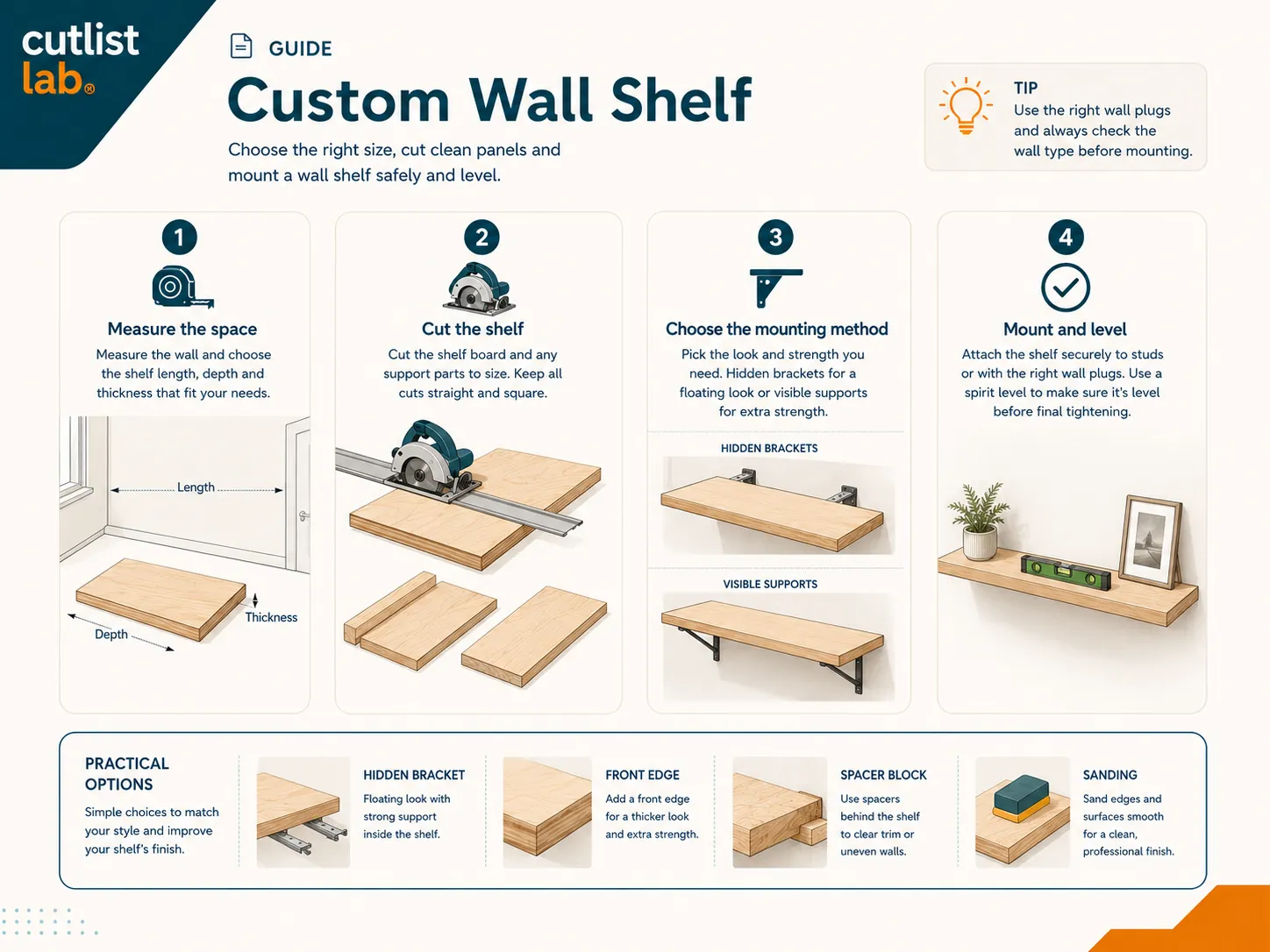
For the floating look you use hidden shelf brackets: steel rods, typically about 1/2″ (12 mm) thick, anchored in the wall, with the shelf sliding over them. The rule most people miss: those rods do not fit inside a 3/4″ shelf. Manufacturers require roughly 7/8″ (22 mm) of shelf thickness as a minimum, and ready-made floating shelves are 1.5″ (38 mm) thick for a reason. The practical route for a DIY build: glue two 3/4″ panels together. Follow the bracket maker's load table (a pair on a masonry wall is typically rated for well over 100 lb / 50 kg), keep brackets no more than about 28″ (70 cm) apart, and know that hidden brackets are not suitable for hollow drywall on its own.
The genuinely hard part is drilling the shelf: holes of ~1/2″ and over 4″ deep have to be exactly square and in line, or the shelf will not slide on or will hang crooked. Drill along a straight batten, use a drill guide, or have someone with a drill press do it.
Which fixing for which wall?
The mounting determines what your shelf can hold, and the wall determines the mounting. Identify the wall with a knock (hollow = drywall or a stud wall, dull = solid masonry) and a test hole: the color of the drill dust gives the material away. Red = brick, fine grey dust with hard going = concrete, white and sandy = sand-lime block, white and coarse while the drill runs through easily = aerated concrete, white and clingy = drywall. Check for pipes and cables before you drill.
| Wall type | Fixing | Working load per point |
|---|---|---|
| Wood studs behind drywall | long screws straight into the studs (usually 16″ on center) | ± 75 lb+ (35 kg) |
| Drywall only (between studs) | metal toggle or heavy-duty hollow-wall anchor | ± 15–50 lb (8–25 kg), poor with leverage |
| Concrete | sleeve or wedge anchor, hammer drill | ± 200 lb+ (100 kg) |
| Solid brick | nylon plug 5/16–3/8″ (8–10 mm) | ± 100 lb+ (50 kg) |
| Aerated/lightweight block | dedicated block anchor, drill without hammer | ± 40–90 lb (20–40 kg) |
The figures are working loads per fixing point from manufacturer load tables, safety factor included; with the tilting leverage of a floating shelf the usable value is lower. Three lessons from those tables: the same anchor holds 7 to 10 times more in concrete than in drywall or aerated block; in drywall a bigger anchor barely helps (the board itself is the weak link); and the screw belongs to the anchor: an undersized screw halves the performance. In drywall, hitting the studs always beats any anchor.
When a floating shelf is the wrong answer
A deep (8″+), heavily loaded floating shelf on drywall with no stud behind the brackets is not a matter of finding the right anchor: it does not exist. Hollow-wall anchors carry 15 to 50 lb per point and cope badly with tilting loads. The honest alternatives: screw the brackets into the studs, mount a cleat or ledger board across several studs first, choose visible brackets (a single sturdy L-bracket is often rated for 150 lb), or use a rail system that spreads the load along the wall.
How much does it all weigh?
A running foot of books weighs a measured 15 lb or so; design for 17 to 23 lb per foot (25 to 35 kg per metre). Decor and frames usually stay under 3 lb per foot. Put the heaviest items above the brackets, not mid-span.
Material and finish
Plywood sags far less than MDF or particleboard and has a clean edge; solid wood is stiffer still. Melamine board looks tidy but is the floppiest and most creep-prone, so keep the span short. Finish cut edges with a clear coat or edge banding. Read the full material comparison in choosing sheet material.
Cut several shelves from one sheet with little waste. Making more than one wall shelf, or a whole set? Enter them in cutlistlab's free tool and nest them out of your sheet goods with the least waste. Handy: leftover offcuts get saved for your next project.
Frequently asked questions
How much weight can a floating shelf hold?
Mostly a question of the mounting, not the shelf: from about 20 lb (hollow-wall anchors in drywall) to well over 100 lb (hidden brackets in masonry, per the maker's rating). As a rough rule, count on 40 lb per support point that sits in solid masonry or a wood stud.
How thick does a floating shelf need to be?
For hidden brackets with 1/2″ rods, at least 7/8″ (22 mm) per the manufacturers; in practice 1–1.5″ is common. The easiest route: glue two 3/4″ panels together, which is also 8 times stiffer than a single panel.
How thick should a regular shelf on brackets be?
With 3/4″ plywood or solid wood you can span about 30 to 38″ at book load; particleboard and MDF manage 24 to 30″ at 3/4″. Need wider? Thicker material, a front lip, or a center support.
Can a floating shelf go on drywall?
Only if the brackets hit the studs behind the board, or a cleat is mounted first. Hollow-wall anchors alone are fine for light decor; hidden-bracket makers exclude hollow walls.
Which anchor do I need for my wall?
Drill a test hole and read the dust: red = brick (nylon plug), fine grey = concrete (sleeve anchor, hammer drill), white and coarse = aerated block (block anchor, no hammer), white and clingy = drywall (toggle bolt, or better: the studs). See the table above for working loads.
How much does a shelf of books weigh?
About 15 lb per running foot measured; design for 17 to 23 lb per foot (25 to 35 kg per metre) and you are safe.