
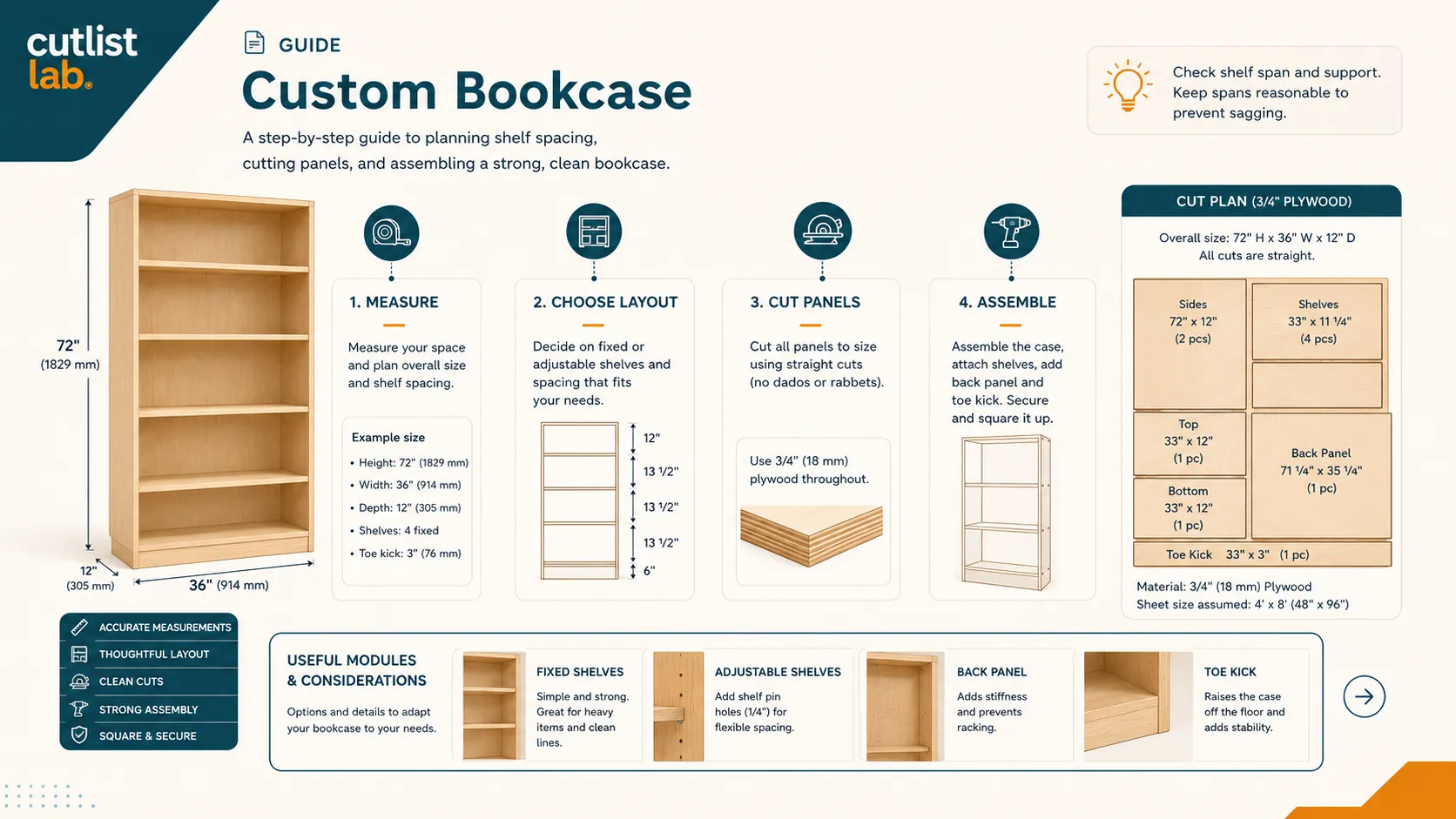
A worked example for this guide: a tall bookcase with a drawer base, complete with a full cut list. Take a look, or drop it straight into the cabinet designer and adjust the dimensions.
Open in the cabinet designer → See the exampleThe right depth
The shelf depth sets how your books sit. For regular books, 8 to 10 inches is plenty; for large art books or binders, go to 12 to 14 inches. Too deep wastes space and your books slide toward the back.
Shelf spacing
Match the gap between shelves to your books. A few rough targets:
| Type | Shelf spacing |
|---|---|
| Paperbacks / pocket books | 9 - 10 in |
| Regular books | 11 - 12 in |
| Large / art books | 14 in or more |
Not sure what is going on the shelves? Go with adjustable shelves on shelf pins. Then you can change the height later without drilling.
Preventing sag
Books are heavy, and a shelf that spans too far will sag over time. With 3/4 in plywood or particleboard, keep the unsupported span to about 28 to 32 inches. For a wider bookcase, a vertical divider helps, along with thicker material or a narrow strip under the front edge of the shelf to stiffen it.
Material
Birch plywood makes a good-looking, stiff bookcase with a clean edge. Melamine-faced particleboard is cheaper and already finished, but sags a little sooner. For an open case with no back panel, stiffness matters even more; see choosing sheet material for the trade-off.
Lay out your bookcase in a few clicks. In cutlistlab's free tool, enter the outside dimensions and the shelf layout, and you get the panel sizes, the number of sheets, and a cutting plan with the least waste. Adjustable or fixed shelves: your call.
On to the cutting plan
Put your parts into a cut list and let cutlistlab nest them. The saw kerf is figured in, so your shelves do not come out a hair short. Handy whether you cut the panels yourself or hand the list to someone else.
Frequently asked questions
How deep should a bookcase be?
For regular books a shelf depth of 8 to 10 inches is plenty. For larger books, binders or art books, go with 12 to 14 inches. Do not make it deeper than you need, or books disappear toward the back.
How much space should there be between bookshelves?
For paperbacks and regular books a shelf spacing of about 10 to 12 inches works well (book height plus a couple of inches to grab them). For large books, plan on 14 inches or more. Adjustable shelves on shelf pins give you flexibility.
How do I keep bookshelves from sagging?
Books are heavy. With 3/4 in plywood or particleboard, keep the unsupported span to about 28 to 32 inches. For wider shelves, add a vertical divider, use thicker material, or run a strip under the front edge of the shelf.