
cutlistlab › Manual › CSV in and out
Chapter 20
CSV in and out
Paste parts in from Excel in one go, and get your cut list back as a file.
Reading parts in
If your sizes are already in a spreadsheet, there is no need to retype them. Open Parts from CSV in the menu, or the Paste multiple from Excel or CSV button below the parts list.
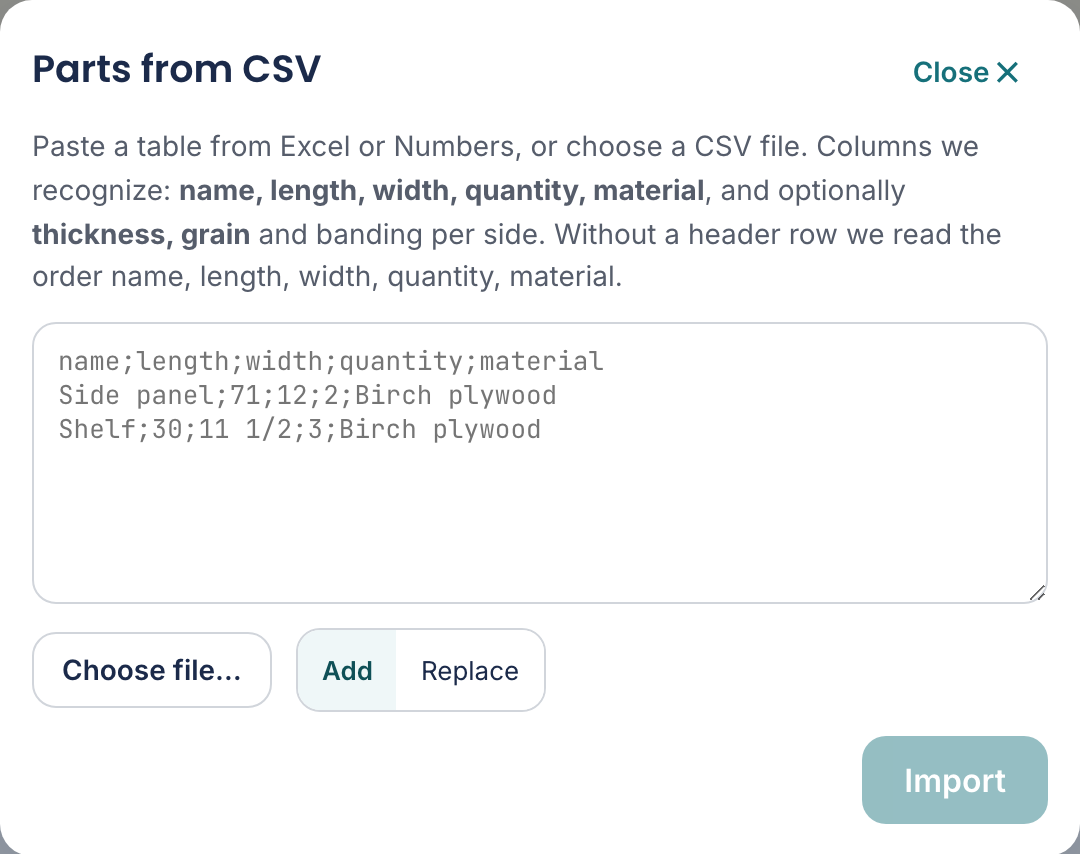
Paste a table from Excel or Numbers, or choose a CSV file. Columns we recognize: name, length, width, quantity, material, and optionally thickness, grain and banding per side. Without a header row we read the order name, length, width, quantity, material.
You can literally copy a block of cells from Excel, Numbers or Google Sheets and paste it into the box. Tabs, semicolons and commas are all recognised.
Below the box it immediately says what it makes of it: 2 parts recognized, 2 row(s) skipped. So you see whether it is right before importing.
Which columns it knows
| Column header | Meaning |
|---|---|
| name | The name of the part. Empty? Then it becomes Part. |
| final_length / final_width | The size the piece must end up at, so including edge banding. |
| cut_length / cut_width | The size you cut at. See Sizes and units. |
| quantity | How many pieces. Empty counts as 1. |
| material | The material name. Must match a sheet in your list. |
| thickness | The sheet thickness, optional. |
| grain | The grain direction, optional. See Grain and edge banding. |
| edge_left, edge_right, edge_top, edge_bottom | Edge banding per side, optional. |
The headers may also be in English or German; the tool recognises them all. Without a header row it reads the order name, length, width, quantity, material.
Under Import mode you choose whether the new rows join your existing list (Add) or replace it (Replace). On replacing, the tool reports it afterwards: (list replaced)
Getting the cut list out
The other way round works too: Cut list as CSV under Export gives you a file with all pieces and their sizes.
That is what a cutting service usually wants: a list of sizes and quantities, not a picture. Ask in advance whether they accept a file and in which format.