
cutlistlab › Manual › Linear cutting
Chapter 14
Linear cutting
Battens, baseboards, profiles and framing: everything you buy by length instead of as a sheet.
When to use this
Not everything is a sheet. Baseboards, battens, coving, framing timber: you buy those by length, and then only one dimension counts. That is what the Linear tab is for.
The calculation is the same idea as with sheets, but in one direction: spread your pieces over the stock lengths so you buy as few as possible and throw away as little as possible.
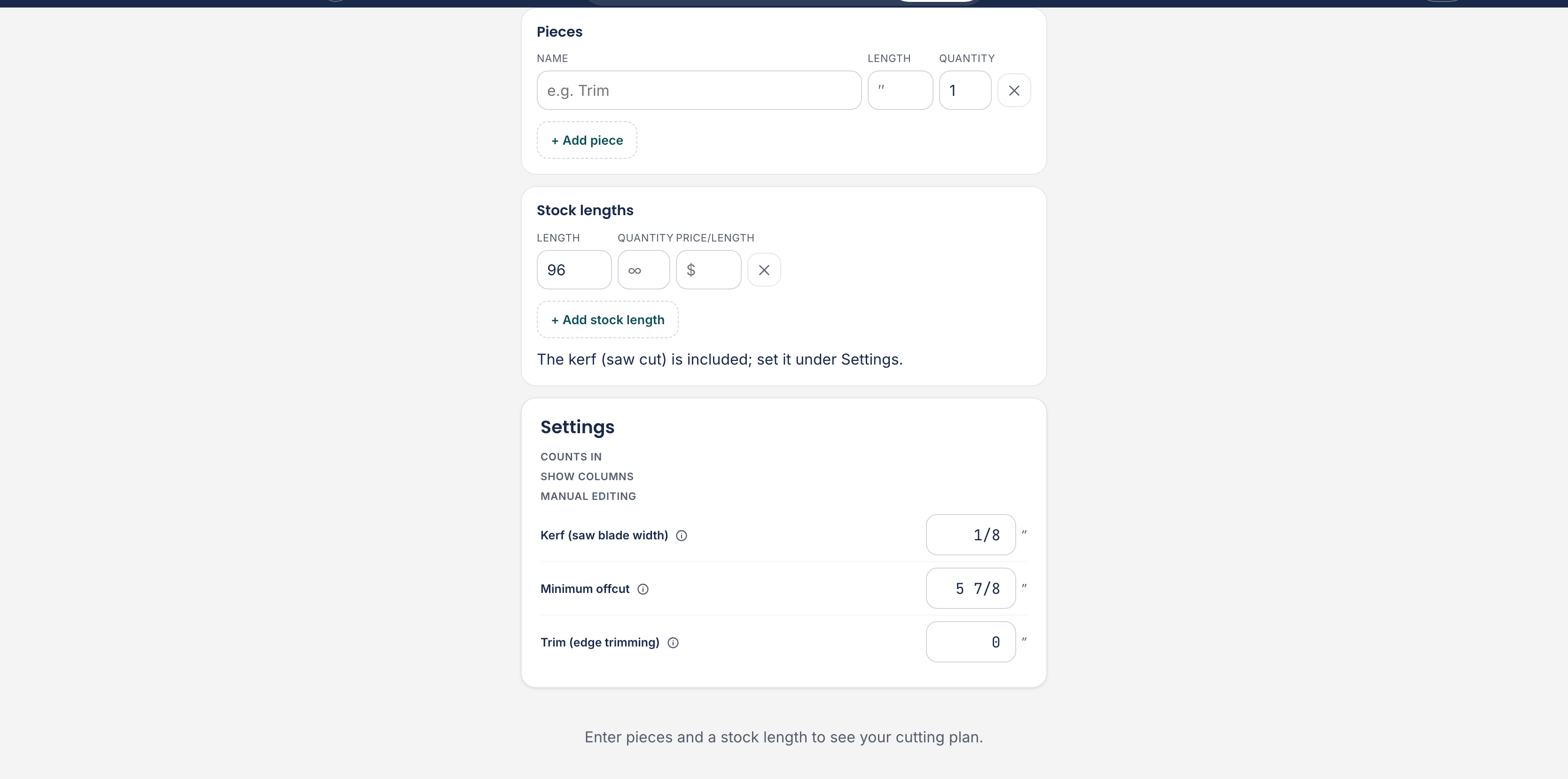
Pieces and stock lengths
There are two lists. Under Pieces you enter what you need: a name (e.g. Trim), the length and the quantity, through Add piece.
Under Stock lengths you enter what the store sells: the length the material comes in, how many you want at most, and optionally the Price/length. Add several with Add stock length if the store has different lengths.
The kerf (saw cut) is included; set it under Settings. That is the same setting as with sheets; see Settings.
Reading the result
Each stock length is a bar on screen, with the pieces in it in order. The legend below says what the colours mean.
- Cut piece
- A piece you cut from this length.
- Usable offcut → stock
- What is left over and long enough to keep. Save to stock puts it in your offcut stock.
- Waste (too small)
- Too short to be of any use.
- Saw cut (kerf)
- What the saw itself removes. With many short pieces that adds up.
On the right sits the balance: lengths, used, waste, usable offcut, cuts and, when you filled in prices, cost.
With Tick off per length you work through it at the saw bench one length at a time; the counter 3 of 7 tracks where you are.
When it does not fit
- 1 piece doesn't fit any stock length. Use a longer length or a shorter piece. This is a hard clash: no stock length is long enough.
- Out of stock: 1 piece would fit, but all lengths are used. Raise the quantity or add another stock length. Here the length is not the problem, but the quantity you entered.
- Enter pieces and a stock length to see your cutting plan. Not enough is entered yet to calculate anything.
Framing from your cabinet design
If you design a cabinet with a plinth, it belongs on a frame. The tool adds that itself: A cabinet with a plinth should sit on a base frame. We added 2 rough spruce 2 × 3 rails to your linear cut list.
Those pieces appear in your linear list with the origin Base frame. Added automatically for the plinth. Updates when you change the plinth. If the given height is not a standard timber size, the tool says so: Note: 4" is not a standard timber size. Cut the rails to size from a 2 × 3.