
cutlistlab › Manual › Settings
Chapter 6
Settings
Saw kerf, minimum offcut, which properties count and which columns you see. Plus the window with language, country and unit.
Two places both called Settings
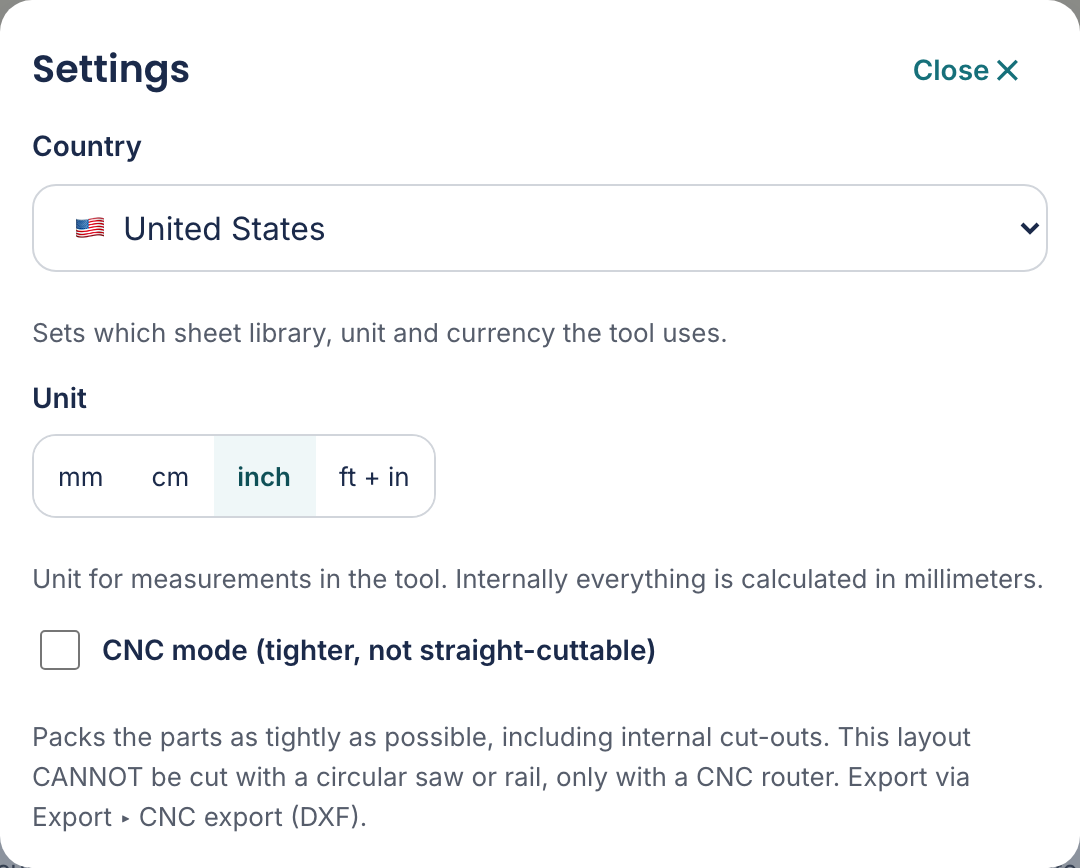
There are two. The Settings block sits in the left column under your sheets, and covers how this project is calculated and displayed. The Settings window opens from the menu, and covers the tool as a whole: language, country, unit.
The Settings block
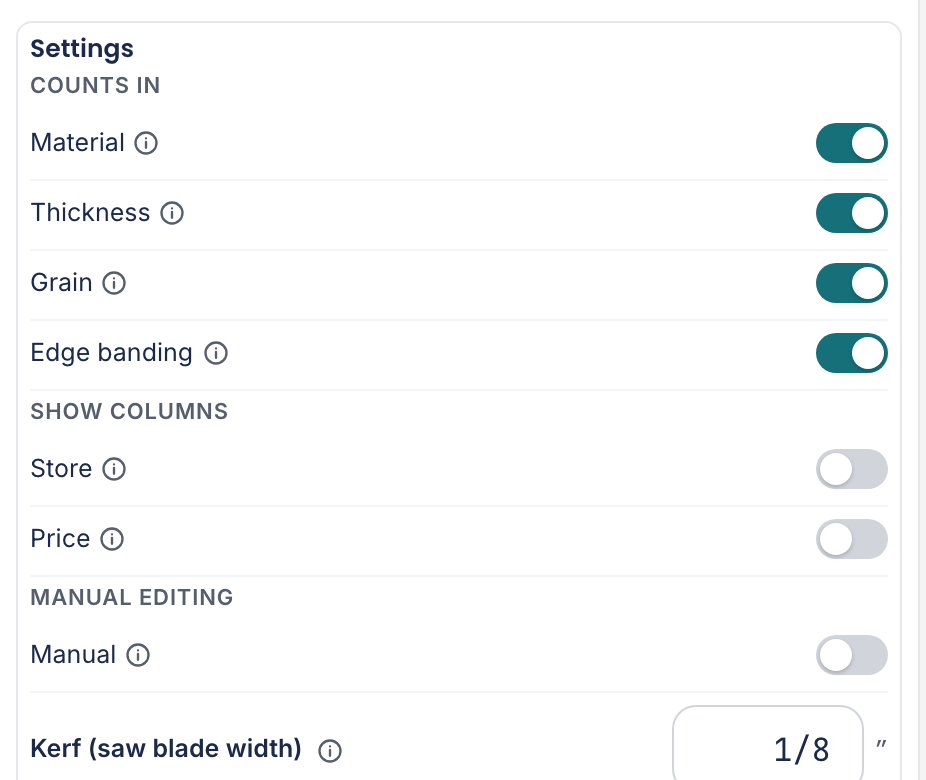
At the top sits Counts in. Those four toggles decide whether a property counts in the calculation. Switch one off and the matching column disappears too, but what you set per part is kept.
- Material
- On: each part only goes on sheets of its own material. Off: material is ignored and anything fits any sheet.
- Thickness
- On: parts with a thickness only go on sheets of that thickness. Off: thickness is ignored.
- Grain
- On: parts with a fixed grain direction may not rotate. Off: grain is ignored and everything may rotate.
- Edge banding
- On: the cut size is corrected per side for edge banding. Off: banding is not applied (cut size = finished size); per-part settings are kept.
Below that sits Show columns. Only shows or hides this column; the setting itself still applies. So these toggles change nothing about the result.
And Manual editing with a single toggle: On: select, drag and lock panels in the plan; the tool recalculates around them. See Manual editing.
Saw kerf and minimum offcut
- Kerf (saw blade width)
- The width the saw removes; applies to all sheets. An ordinary circular saw blade takes about 3 mm, a plunge saw with a thin blade sometimes 2.2 mm, a table saw with a wide blade 3.2 mm. Set it too low and your last pieces come out just too short.
- Minimum offcut
- A leftover piece counts as a usable offcut if its short side is at least this; smaller is waste. Anything below that is called waste and is not kept. Set it higher when your shed is already full, lower when you want to keep small pieces too.
- Trim (edge trimming)
- Edge trimmed off each side of a full sheet to remove the factory or rough edge. Reduces the usable size; does not apply to offcuts. 0 = off. Useful with a rough sheet or a damaged edge. Leave it at zero when your sheets are cut cleanly to size.
The Settings window
- Language
- Choose the language of the tool. See Languages, countries and currency.
- Country
- Sets which sheet library, unit and currency the tool uses. Country sets the stores, prices and currency. Independent of the interface language.
- Unit
- Unit for measurements in the tool. Internally everything is calculated in millimeters. See Sizes and units.
- CNC mode (tighter, not straight-cuttable)
- Packs the parts as tightly as possible, including internal cut-outs. This layout CANNOT be cut with a circular saw or rail, only with a CNC router. Export via Export ▸ CNC export (DXF). Leave this off if you work with a saw.